Wednesday, April 6, 2011

New Resource for NZ Teachers

It's been some time now since TVNZ7 first announced they were making a DVD available to schools - and nothing arrived. Until today - when an email arrived announcing that the DVD would soon be here along with the announcement that the TVNZ7 Learning Hub was to go live today.


Here's what the website has to say ...


The TVNZ 7 Learning Hub explained
Welcome to TVNZ 7's Learning Hub, a destination for teachers, parents and students offering quality education resources based on popular TVNZ 7 programmes.

Through partnerships with other organisations we have compiled education resources to suit the New Zealand curriculum. All of the resources link through to our TVNZ OnDemand page where you can view the accompanying episode.

So, what's available? Well, not a lot at the moment - there are a dozen or so episodes of the Ever Wondered TV series - I had a look at one on astronomy (just because I'm interested - sad eh?) and was pleasantly surprised to find a pile of links through to resources and student activities on ScienceLearn 

One thing I did find was that it was easy to get lost in the standard TVNZ7 website and from there to TVNZOnDemand - and end up watching missed episodes of Coronation Street and others. 
But - all in all - a welcome addition to local content - let's see how it develops over the coming months.

Monday, April 4, 2011

Learning with a Real Purpose

Two years ago I had a class that studied the 2008 Horizon Report and published a wiki as the end product of their work. What I have found interesting is that while they finished their work 2 years ago, their wiki site still attracts around 50 unique visitors per day from countries like the US, UK, Russia, Canada, Ireland and Australia - oh, and a few from NZ.
This reinforced to me the importance of having a real purpose for learning. In the past if students had created a research report on the Horizon Report it would likely be be shared with at most two people - the student and the teacher. Here - the students have created a resource which is being shared with upwards of 1000 people per month.
Alan November talks of learning with a real purpose in his TEDxNYED. This neat little 15 minute talk of several student stories has one really cool one - the one about the 13 year old girl using Fan Fiction. "When I wake up I have to decide - do I write for my teacher or do I write for the world?"
Enjoy Alan's talk - he's a great thinker and practitioner.

Sunday, March 27, 2011

iPad, Feedler Pro & EverNote - great combo for sharing

For some time now I have been looking for an easy way to share those entries from the various blogs I read with some of my colleagues at school. What I wanted was a way to take those posts from my RSS aggregator (Google Reader) which I access via Feedler Pro from my iPad, and collect several different posts into the one message, keeping all the graphics and formatting.

Feeddler Pro has just added the option of sending a blog entry to EverNote. I have had an EverNote account for over a year now, just never really used it much. That's about to change.

I can now send the full articles from Feedler Pro directly to EverNote. Then by logging onto my MacBook Pro or Dell tablet I can use the full version of EverNote to merge the articles according to then tags I gave them on my iPad - and from there email the result to those who I think should get them.

Not perfect - but it works better than any other way I've found so far.

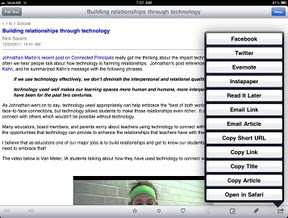
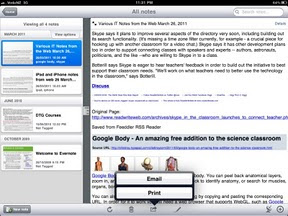
Here are a few screen shots showing the process.


Screen from Feedler Pro showing full options.


Once merged in EverNote you can email the set of articles (either from iPad or other computer).

Why do I email the merged article rather than just send links to the original? I want to make it as easy as I can for my colleagues to see the info - and I don't want to take the risk that they might not follow the link ...


Posted using BlogPress from my iPad

Wednesday, March 16, 2011

Is this the future of K-12 education?

Bill Gates hints to the audience at the end of this TED talk by Salman Khan that "you have just seen a glimpse of the future of education". I wonder if you agree?

To start with, here's the talk - it's 20 minutes worth, but it is worth it imho, particularly if you are a teacher of maths, science or geography - and from memory the Khan Academy also has a growing library of accounting and economic resources too.


So, is it the future of education?
Alan November gave a recent interview on TV in the US where he quoted brain research stating that "if you make the mistake at home in your homework, chances are you'll make the same mistake in the test - even if the error is corrected the next day".

So, maybe Khan is right.
With digital video content -

  • you can watch it as long as you like
  • you can rewind it as often as you like
  • you don't need to be made feel uncomfortable by taking "an age" to get the point about something
  • you will always get a consistent approach from the video
  • you won't be told "I've already explained that twice"
Are you prepared to turn your classrooms around as Khan suggests?
What might some of the pros and cons of this approach be?

Thursday, December 2, 2010

Is this a "Foundation for Excellence"?

"Digital learning can customise and personalise education so that all students can learn in their own style and pace, which maximises their chances of success at school and beyond ...." So says the report "Digital learning Now" from the Foundation for Excellence in Education.

The report lists 10 elements of high quality digital learning. Those of you who follow the push for educational reform won't likely find much new here. But what you will find is a list of a few key policy directions that stand a chance of delivering on the promise that technology has for education. Let me give you an example or two ... then you can digest the report yourself ... luckily it is one of those reports that is only a few pages long and doesn't waste time on putting in irrelevant stuff ...

Point 2: All students have access to high quality digital content and online courses.
Policy directions:
  • do not restrict access to courses or content using class numbers, budget or enrolment caps or other such traditional measures ... just make them available
  • do not restrict access due to geography
  • do require school diplomas to have at least some online course completion requirement
Point 3: All students can personalise their own learning using digital content from approved providers
Policy directions:
  • allow students to take online courses full time, part time or by individual class
  • allow students to enroll in multiple courses from multiple providers
  • allow enrollment all year round
  • no limit to number of credits take
Each of the 10 elements has a similar "simple" look - a brief statement of the element and a few policy directions.

I wonder how this might play out in our environment? I have made several suggestions in the past in varying formats that I believe it is inevitable that the nature of learning in schools must change - and I liken it to Chris Anderson's view of Long Tail Economics - I just can't see education in its current form for some students being valid for too much longer. There will likely be a need for bricks and mortar for some - but for others, why? Why when there are better options?

Anyway, read the report, and keep the discussions going - and try and implement a little of the directions every day in your schools.

Friday, November 26, 2010

Four months with an iPad

Little bit late this one. The reason is time. Just so much happening at the moment. Still, am happy to report that this little iToy is still a favourite tool of mine.

The awesome battery life is a huge plus. The ability to type a few notes is great - though I sometimes wonder just where the predictive text comes from - some the interpretations are bizarre. I have pretty much given up my Pulse Smartpen since becoming attached to this iPad. I record all notes from seminars or meetings directly into Pages and sync either via iTunes or DropBox with my other laptops.

I haven't looked to print anything - why would you when you've got the live document with you. I'm really please Google has finally brought a basic form of editing of Google Docs via iOS or Android. I can now create new documents on my iPad and iPhone without using Docs to Go - though Docs to Go still has more functionality.

I still think Feedler is good as an RSS reader for my Google Reader account.

The biggest draw back is the 3G network ... Last weekend we used the iPad when geocaching around the Miranda coast - the network performance was pretty poor even though the indicators showed full strength 3G.

So yes, the iPad is great. I've upgraded to iOS 4.2.1 and look forwardbto seeing if the multitasking is any good.

Stay tuned!


- Posted using BlogPress from my iPad

Thursday, November 25, 2010

Just what is the point of the current curriculum in schools?

Conrad Wolfram gave a talk at TED in Oxford earlier this year. it's just been posted on the TED site. And wow, does it pose some big questions. If you are a maths teacher, you will likely form an immediate view of what he is saying. I don't think there is any middle ground here. You will either agree with him or you won't.

But there are bigger questions here too than just those pertaining to maths. The way in which we very likely approach many subjects in the school curriculum, for example. And the point about exams ... I think I've made this point several times in the past.

I've shown WolframAlpha to Year 12 students about to embark on their IB extended essay research over the past 12 months. What I find truly scary is not so much that they haven't seen WolframAlpha before, but that many of them still don't even know that there are search engines other than Google. And even scarier, that Google even has an advanced search tab, and worse, you can look through Google Books or Scholar.

The whole point of using computers for powerful things ... not trivial things ... comes out in Conrad's talk. (He makes reference to an online tutorial showing how to manually solve a problem.)

So, this is I think one of the better TED talks I've seen. It asks some serious questions. It hints at a solution. I wonder if you agree? I rate this talk up there with those of Hans Rosling and Ken Robinson, both of whom I have featured on this blog in the past.

So - take 17 minutes of your valuable time and have a look.