Showing posts with label learning. Show all posts

Tuesday, June 3, 2014

The Future of Learning

Sugata Mitra is known for his "Hole in the Wall" research project in India in 1999. He's known for the TED Talks he has given. He's known for being the TED winner for 2013.

Today I had the privilege of listening to him for 60 minutes as the opening keynote speaker at EduTech 2014 in Brisbane. This post has a few of my observations and then links to his previous research.

Let's set the record straight from the start. This guy is so genuine. He's a modest, thoughtful, dedicated, intelligent, sensitive, reflective researcher. He speaks from his heart and his mind.

So - what did he have for us today? Sooo much ... where to begin ...

I'll begin where he did. He gave the now standard "today's schools are designed to produce conformity, obedience, instruction following" that is now the hallmark of many - Sir Ken Robinson in particular. But that's OK - because there are young teachers at this conference for whom the rationale for educations systems being constructed the way they are might be new.

But he quickly moved to the killer stuff for me. Here's my paraphrased backstory. He started some research in a non-English speaking area. The kids were Tamil. They were 12 years old. The question he left them with was something about DNA. They didn't speak English. The resources he left them with were basically Google and in English. As he states "a pretest would see then score zero, and when he returned in 3 months, a post test would show them score zero". He was stunned at the results. And so presumably is anyone who has followed the story.

So, he's gone on to show that 9 year olds left alone with an internet connection can answer GCSE questions and retain the information for 4 years!

He asks the question "Is knowing obsolete?" Not to say that "knowing how (and when) to know" is obsolete - quite different!

From his research and commentary we know that examinations see students at their lowest "ebb" for learning. We know that the "friendly adult" (aka Granny cloud) is a powerful motivator for kids. We know that his SOLE ( self organising learning environments) work. We know that these are potentially in conflict with what most think of  as 1:1 technology initiatives. We think (well, he does, and I don't know enough about them, but I know he knows more than me!!) that these SOLE environments are on the edge of chaos according to "Complexity Theory".

So what are my takeaways ...

  • explore through practice these ideas 
  • get some big questions applicable to our environment
  • get some supporting "friendly adults" to support
  • change the collaborative space
  • enjoy the ride and the results
So - here are some of the backstories from Sugata. Thanks for the opportunity to share!


Saturday, September 7, 2013

Change comes from the ground up.

How to change education : from the ground up.

Readers of this blog will know that I am a big fan of Ken Robinson. But this time he goes that little bit further, IMHO, and starts to touch on those aspects that we, as teachers, can actually work on to see change - the change that we've all been on about for the past 10 years ... As usual, the Knight says is better than anyone - so listen to this carefully ... and then I share some other thoughts below.

Wow! There is so much in these 24 minutes. What follows are my observations and thoughts - but I'll couch my comments now by saying that this video, plus what I read in the Herald today have given me further insight into my own position on learning and teaching and what should be done. So this particular post will have a couple of sequels ... so apologies if it seems a little disjoint at the moment. 

So - my key take always from this

  • The basics of education are "why we do this", and not any particular group of subjects
  • purpose of education 1: economic - but the economic environment now is vastly different than the one in which current systems of education were set up ... And today we need adaptability and creativity (IBM research). These are 'bottom line' competencies that business want today but they claim that our largely one size fits all system discourages.
  • Purpose of education 2: cultural - in an increasingly global environment, we need to understand other cultures and perspectives well. Value systems are not the same. It's interesting to note that he refers to the Middle East dramas at present. I think you only need consider the changes in the likes of Egypt, Libya and the like over recent years - changes there have not been driven by the leadership in the country - it has been by the people in the street finally saying they've had enough.
  • Purpose of education 3: social - and we need to engage. Our society needs to be 'rediscovered' by every generation - and we can't do this without open debate.
  • Purpose of education 4: personal - education is about the individual. We know individuals are diverse, everyone has different talents, interests etc ... But a key driver in education today is still conformity.

Robinson then makes the point about governments in general ruling from the top down - the command and control position. And I think about our current environment here in NZ (by current I mean over the past 10 - 15 years) where it seems to me that the teacher unions and many of the teaching profession are in conflict with the Ministry of Education and the Minister in particular. "You cannot run a system by alienating the people who do the work."


So, if getting back to basics means getting back to the student/teacher interface, and don't clutter it with other stuff unless it adds to that relationship, then we will have to 'undo' a lot of the "institutionalised" structures we have built. I have maintained for a while that there is far too much 'compliance cost' in education these days - teachers are spending too much time doing everything but teaching - there is a form (or several) for everything. Then of course there is the incredible workload that is the assessment regime.


There are a few other points that Robinson makes in the last 5 minutes of his talk that I think might be in complete contrast with an article I have just read from Professor Elizabeth Rata from Auckland University, so I'll stop for now and revisit this is another post. I have the feeling that, for me anyway, there are a number of issues that are becoming increasingly clear about what we can do and where we should head, and I'm looking forward to trying to put all this together over the coming weeks.


Thursday, December 13, 2012

Conveyal of Content is a Commodity

"Education teaches you to cope with certainty."
"Learning teaches you how to cope with surprise."
"Every day is a surprise. There is no certainty."

Stephen Heppell is well known internationally for his research and practical solutions and suggestions for the future of education. The three quotes above are from him - as part of a video put together about the future of learning.

There are a number of things that resonated with me when I watched this video. I'll mention them here and then put the video in for you to watch.

1. The video brings together the thoughts of a number of people that I have to some degree or other heard of and heard from in the past. Heppell of course has been to NZ a number of times and has somewhat of a legacy here. Seth Godin is another well known IT, marketer and thinker. Don Tapscott - whose quote opens the video - has written extensively about "Growing up Digital" and "Grown up Digital"
2. "The graduates of Education must be uniquely valuable, not identically valuable" - so says David Warlick.
3. More children will leave school over the next 30 years than have ever left school. Period. So, if we can make a small change now we will impact a lot of people.
4. I had only the night before seeing this video signed up to a course at coursera.org. So, I was pleased to see something I had gone past the mere viewing stage to see what the next level was like was featuring here. Labelled as the "world's best courses, on line, for free" I'm looking forward to taking my first course with anything between 10,000 and 100,000 fellow course members come February next year. Yes - you read right - 10,000 or more students. [Of course there are other similar ventures - like Harvards and MIT's edx site.]
5. A big point for me is one that I have made on and off now for several years. And that Daphne Koller says far more eloquently than I ever will... "conveyal of content is a commodity".

Here's the video ...


So - what will make the difference to the student of today ... the leader of tomorrow? Whatever you do, don't get bogged by the content - it will change and there are far better mechanisms than you to deliver it! Do get bothered with sharing the learning journey with those in your care. Foster creativity. Foster mistakes. Embrace that which makes the journey easier. Challenge existing "truths". And if you must assess, then build a meaningful assessment of learning that goes past the narrow confines of the examination paper and the examiners marking scheme. [I mean, so what if the student doesn't use the exact word that the examiner wanted them to use ... or they have just recorded an answer using one less line of working than the examiner was expecting... or they used a diagram to explain a concept that the examiner was expecting words for ... apart from the examiner, who cares? In "real life" you get the opportunity to discuss opinions and ideas ...]

Wednesday, May 30, 2012

Redefining School Part 3

Still at Northern Beaches.

So - how does the school organise professional learning for staff with the large classes, technology to enable and pedagogy to support?

Each Monday afternoon all staff attend PL. Staff request sessions via word of mouth or an electronic request system. These requests are prioritised by the senior teacher i/c of PL and each Monday anywhere between 5 - 12 sessions are offered. Teachers opt in and their attendance is recorded in a reporting system that delivers a report to the HoF each term showing what has been attended by whom. This then provides a degree of review for future PL planning and helps identify for HoF, teacher and PL organiser any issues at the respective levels.

Expectation is that all staff attend. Reality is that at least 80% do. And because there is a record of who attended it is easy to identify and follow up those who don't.

Sessions might be on Moodle (for the first 2 years they were pretty much all Moodle); pedagogy, teaching methods, innovations, spirituality.

This information then also feeds into the appraisal system.

Once each term all staff spend 3 hours on a Wednesday (3:30 - 6:30) on a PL intensive which gives them enough time to do something substantive.

Tuesday, May 29, 2012

Redefining School Part 2

Northern Beaches Christian School featured in my last post. This post looks at their middle school "Learning Matrix". The students talk about the "matrix" in almost as reverent a term as we do about the movie. That's where the similarity stops though!

Basically the matrix is a combo of Bloom and Gardner with a range of activities in the matrix that are either compulsory or voluntary. Students must do the compulsory and can choose a range of the voluntary. This is a basic graphic representation of the matrix for Year 7 for term 2.
Students work on their "matrix projects" for around 6 x 70 minute sessions every two weeks, though as a year 7 syndicate teachers also share some of their maths, english, science and history work in the matrix too. This term the verbal tasks were all from the history curriculum and students were building websites or creating travel brochures in the "creating" and "evaluating" sections of the matrix. 

Students work to achieve a certain "points total" for the term.

Each task (cell) is mapped to a range of outcomes from the NSW curriculum and teachers and students use a range of organisers to track their progress against these. These organisers range from printed sheets to Excel spreadsheets, but not many are done via Moodle - though I wonder if they will be able to use the Moodle rubric from 2.2 to make this more integrated than it is now.

Collaboration amongst staff is crucial here. The team/syndicate agree on the tasks and where they sit - after all, they all have to work with all of the students.

As a planning and curriculum coverage tool, this type of grid is useful in itself. Coupled with specific activities aimed at the various intelligences and taxonomies, it is even more useful. Linked to the LMS (Moodle) is yet a further strengthening of the entire process.

There is an element of gamification in the curriculum too. So while the tasks themselves are somewhat authentic, they also form part of the overall theme for the term which is usually related to some notion of puzzle/competition/investigative process. The students certainly seem to enjoy it. And that's important. In fact - the school believes that their behavioural problems have decreased by some 75% in the past 2 years as a direct result of the gamification of the curriculum where possible.

Redefining School Part 1

I'm lucky enough to be in Sydney this week touring a range of schools with a group of teachers from Christchurch and Southland. The purpose of the week is to learn about and from some of the schools and the remarkable teachers in them about technology initiatives that are working.

This post is the first of a few. Initially I thought I'd do each school as a separate post, but after today's session at Northern Beaches Christian School that idea went out the window. So much to talk about. So - humour me while I try and make a few points about some of the stuff I saw today.

Northern Beaches Christian College was the venue for today. We were hosted by an interesting character. Steve Collis has the neat title of Director of Innovation at the Sydney Centre for Innovation in Learning (SCIL). Now, the SCIL was basically invented by the school, so that was the first learning byte - if you want something, invent it. (Sound like Alan Kay anyone? "Don't worry about what anybody else is going to do… The best way to predict the future is to invent it. Really smart people with reasonable funding can do just about anything that doesn't violate too many of Newton's Laws!"-  I love that quote from 1971).


Well, Steve is a bit of showman. But - what I found by following him around the school was that this was one of the few schools I have been to where the talk was matched by the walk. Certainly in the Year 7 - 9 classes I saw anyway.


So ... what were the takeaways worth remembering ...
  • they've merged the physical space with the virtual space
    • so - they have large teaching spaces - they've knocked down walls over about 10 years and now have large teaching spaces where learning happens. Up to 180 students and 6 teachers in the same space at the same time doing ... kind of the same thing, but with as many options as they have been able to agree to do as a team.
    • they have learned the need to minimise noise by using special roofing tiles and walls that really do reduce noise - we were in a technology space where 75 students were working with various bits of equipment and talking - and we could see them from the other end of the room, but we couldn't hear them!
    • What follows are a couple of images of some of the spaces. Comments as appropriate.

    • what was interesting in this space was that the students (Year 7) were just at the end of a whole class intro session on whatever the content was ... so typical team teaching lecture style - nothing different, right? It was what happened when the leader/teacher said "get to work" that something was different. There were around 120 students in this group. They all got to work immediately - there was not a sound - so I presume it was an individual task - but not a sound. So - not sure that this was anything more than team teaching, but the students were clearly used to it and knew what was expected of them.
    • Next space was a year 9 "Matrix" exercise - (more on the matrix in another post - its worth its own post). In this class I spoke with a couple of Year 9 students and one of the teachers. 
    • poor photography aside - you can see that the space is huge (this shows about half the space). Teachers simply worked with individuals or groups as required. Students knew what they had to do for the entire term and they were all working on their various tasks. Obviously the make-up of the task is important to this, that's the "Matrix" I'll refer to next post. The three students I spoke to could tell me exactly what they were doing and why and could easily navigate their online portal where all resources were. The portal is just Moodle (and 1.9 at that!) - but they have configured a landing page with the appropriate links to the pages/resources that students needed.
    • the furniture is not standard either - there are a range of table types and sizes, and chair sizes and styles - and students are free to arrange the room how they want.
    • they talk of 3 types of space 
      • the cave - a student wants to work alone
      • the campfire - a small group want to learn from a master story teller
      • the watering hole - everyone goes there at some stage and informal learning about anything can happen there
    • each room or learning space can be configured to any or all of these at the same time
    • the teacher I spoke with showed me how the Year 7 teachers had decided on the activities for the Matrix and how they monitored student progress and achievement. Despite all the work on Moodle, they used an Excel spreadsheet that linked the scores students gained from completing matrix work through to a map of the curriculum outcomes they were working with - so there is no doubt that there is a lot of teacher effort going in here.
    • This next image is one from a newish building - taken using Photosynth on my iPhone (one of the more useful Microsoft tools). What this doesn't show is that there were 150 students in this Year 7 group - all working on a social studies project.
    • The large screens here were simultaneously playing a series of video and still images designed to evoke some feelings amongst the students. The teacher I spoke to didn't know if the theory behind this playing of "subliminal images" worked or not - but felt there was some theory there.
And I guess that's the first takeaway. The school has clearly decided that they needed to back their changes with some theoretical base as well as a degree of "Alan Kay" - and invent their own future. So, the learning spaces are big and for a fair chunk of the school week students work in very large groups doing any number of tasks that are moderated by a team of teachers - who, while they have some nominal "class" teacher role, spend their time working with any of the students.

The kids I spoke with loved the freedom to "do what they want to" even though they were basically just picking from a set of given projects - but the range was pretty impressive.

Steve talked to us about a "love of learning" - in fact, the school holds this more important than outstanding academic results (though they will be related of course). They have taken time (10 years so far) to build the physical and virtual environments that overlap to provide the overall learning environment. The student numbers have increased from 200 in 2002 to 1200 in 2012. All students from Year 5 - Year 12 bring their own device - so students have Mac Books, iPads, Acer, HP, Dell, .... They use whatever applications they want. Staff cope. 

The environment supports students ("free range chickens" Steve called them) and their ability to self navigate the curriculum. They trial it in small bits (bunny hops they call them) and modify - but always seeking to make the students central and use the environment and technology to facilitate.

It seems to work. In the next post I'll talk about the "matrix" and how they bring teachers along via their professional learning program. 

Monday, July 11, 2011

What price 14000 resources for teaching and learning ... try free!


The PBS (public broadcasting service) has a track record of providing some pretty useful resources for teachers. I've used several resources (like the "Growing up online" resources) many times. Now PBS have made over 14000 resources available free of charge for teachers here.

As you can see from the image above the search options are pretty standard, and once your search is done you can see the type of resource (see below)


According to the PBS site ...

"This next-generation digital media service empowers PreK–16 educators to re-imagine classroom learning, transform teaching, and creatively engage students. It brings together the best of public media, produced specifically for educators, from PBS, WGBH, and 55+ public media partners. This flexible service includes high-quality content tied to Common Core and national curriculum standards. The service is freely available to educators as a basic service that can be enhanced with premium solutions for schools and districts-designed for seamless media integration and customization. The basic service offers:
  • Unique access to best-in-class resources from PBS producers and partners and technology resources tied to Common Core and national curriculum standards
  • A robust content library of thousands of digital core curriculum resources, designed with today's student in mind
  • Carefully created, purpose-built media: videos, interactives, audios, lesson plans, multimedia, professional development, and more
  • Ability for educators to search, save, share, and review content
  • Cross-platform flexibility to display on classroom presentation tools to mobile devices."
and more ...


"There are five types of media resources in the service: Audios, Documents, Images, Interactives, and Videos. Many resources include supplemental materials such as lesson plans, discussion questions, and background essays.
To view a media resource, first click on the media resource title or thumbnail image of a resource from your search results. This will open the resource page identifying additional information about the resource. Click on the large image to play an audio, video, or interactive, or, to enlarge a document or image resource. Videos can be enlarged to full screen by clicking on the four arrow icon to the right of the volume control below the media image.
The service includes individual resources and groups of resources designed to be used with one another. Group resources include a "Group Index" on the right side of the page. To view an individual resource within the group, click the resource within the index. It will appear on the left side of the page."

To me, this looks like it should be part of every school's repertoire of online resources.

Sunday, March 27, 2011

iPad, Feedler Pro & EverNote - great combo for sharing

For some time now I have been looking for an easy way to share those entries from the various blogs I read with some of my colleagues at school. What I wanted was a way to take those posts from my RSS aggregator (Google Reader) which I access via Feedler Pro from my iPad, and collect several different posts into the one message, keeping all the graphics and formatting.

Feeddler Pro has just added the option of sending a blog entry to EverNote. I have had an EverNote account for over a year now, just never really used it much. That's about to change.

I can now send the full articles from Feedler Pro directly to EverNote. Then by logging onto my MacBook Pro or Dell tablet I can use the full version of EverNote to merge the articles according to then tags I gave them on my iPad - and from there email the result to those who I think should get them.

Not perfect - but it works better than any other way I've found so far.

Here are a few screen shots showing the process.


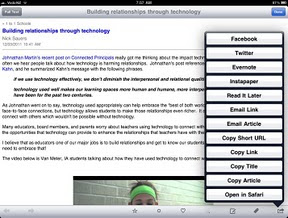
Screen from Feedler Pro showing full options.


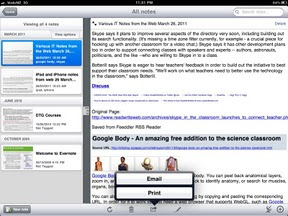
Once merged in EverNote you can email the set of articles (either from iPad or other computer).

Why do I email the merged article rather than just send links to the original? I want to make it as easy as I can for my colleagues to see the info - and I don't want to take the risk that they might not follow the link ...


Posted using BlogPress from my iPad

Wednesday, March 16, 2011

Is this the future of K-12 education?

Bill Gates hints to the audience at the end of this TED talk by Salman Khan that "you have just seen a glimpse of the future of education". I wonder if you agree?

To start with, here's the talk - it's 20 minutes worth, but it is worth it imho, particularly if you are a teacher of maths, science or geography - and from memory the Khan Academy also has a growing library of accounting and economic resources too.


So, is it the future of education?
Alan November gave a recent interview on TV in the US where he quoted brain research stating that "if you make the mistake at home in your homework, chances are you'll make the same mistake in the test - even if the error is corrected the next day".

So, maybe Khan is right.
With digital video content -

  • you can watch it as long as you like
  • you can rewind it as often as you like
  • you don't need to be made feel uncomfortable by taking "an age" to get the point about something
  • you will always get a consistent approach from the video
  • you won't be told "I've already explained that twice"
Are you prepared to turn your classrooms around as Khan suggests?
What might some of the pros and cons of this approach be?

Saturday, August 7, 2010

A Month with an iPad

So, 1 month in to my iPad journey - some thoughts. I started this exercise with an objective of trying to replace my laptop as my prime computing tool. That's a big ask - because in my role as an IT director at a large independent school I have a number of different functions that I need a computing device to do.

In no particular order I need to
1. Provide pd to staff at all levels
2. Presentations to staff, students and parents
3. Research into new and emerging technologies
4. Teach - I teach ICT to middle school students and we do anything from web design to 3D modeling. So I need applications to do video editing, photo manipulation and animation.
5. Interact with our various administration systems, including how we manage these devices in a large deployment.
6. Maintain my blog and other websites.
7. Have full editing access to Google Docs or other such cloud tools.
8. Must be capable of projecting via a data projector.


We run pretty much a Windows environment for our students - they have laptops running either Vista or XP - and while we are almost clear of running Windows only software, there are still a couple of areas where we have a dependence on that platform.

So, in my explorations over the last few weeks I've been asking myself the question - "can we introduce an iPad as the student device at our junior levels?" All of this while being mindful of the fact that the absence of support for Flash will make an impact?

Some findings so far ...

1. While the iPad doesn't support most applications via a data projector, if you jailbreak it and install TVOut2 you can get pretty reasonable projection capabilities - enough to satisfy me that this aspect of presentation and teaching is well enough covered.

2. It would be fair to say that while I can manually configure proxy connections for the iPad and Safari works quite happily over our network, none of the other applications that use the network by default currently work. For example I can not access the App Store or mail etc. Now, we do have an issue with iTunes on our PCs too - unless you have Safari installed on a PC and have it configured, then iTunes doesn't connect properly - this is a relatively new phenomenon for us and as yet we have not spent any serious time trying to resolve this issue. So, this is looming as an increasing priority if I can satisfy myself that other issues of multimedia creation are doable for students.

3. I have found the lack of Flash support more annoying than frustrating. That said, there are a couple of apps that we are currently deploying that make use of Flash - MyPortfolio.school.nz is one, and the Aviary suite of tools is another that I was planning to introduce but will now have to find an alternative to.

4. I must that when I spoke with a couple of our DPs a week or so ago I made the comment that perhaps we may be a year away from an iPad type device in our environment. I based this on not having found a video editing package or a 3D modeling tool. I now have - at least at a superficial level - but enough to make me not too concerned about this.

5. Google currently have an issue that they only allow editing of spreadsheets through their mobile application - this is a pain. In addition, there is a bug in the new Google Docs that stops you being able to download and edit documents created in Docs through such tools as Docs To Go - I understand that several attempts have been made to fix this issue but it remains unresolved as far as I can tell.

6. If we can get a web front end to our main admin system sort then we should be ok with our various admin connectivity for teachers - the rest of our stuff is based around SharePoint and Moodle - there is a mobile app for Moodle should straight web connectivity prove an issue. We are still very early in our Moodle stages with no deployment yet, so if we manage this component with our developers it should not prove an issue.

7. Maintaining blogs and websites is proving a bit more problematical. The likes of Yola and Weebly make extensive use of Flash and so are not a happening thing. I've yet to try the likes of Google sites or other tools, so have a little more work to go here. Maintaining my this blog with BlogPress (as I'm doing now) is OK for basic stuff, but not really a good enough editor for my liking. I'll explore the WordPress app for some new blogs we're setting up for a couple of classes and see how they go.

8. At this stage the iPad still relies on having access to another computer of some type for various functions - the extent of this for a school environment has yet to be considered (by us) to any extent.

9. The "instant on" is a huge benefit to a mobile student population.

10. The battery life is awesome. Easily get a day without a charge - so students won't need to bring a charger to school.

That's about enough for the moment - more to come as the exploration continues, but suffice it to say that I am getting happier with the iPad as a primary computing device by the day. Sure there are some big issues still to resolve, but with functionality in other areas (application wise) seemingly clo to being resolved, at least we can look at the big issues with a purpose.

More as we continue our journey.

Wednesday, May 26, 2010

"Tread Softly on My Dreams" - Sir Ken Robinson at TED 2010

He's back. Sir Ken Robinson spoke again at TED earlier this year. Entitled "Bring on the Learning Revolution" Sir Ken makes another passionate case for transformation of education systems - not just a reformation of them.
He talks of "dislocation",
He talks of "how do you innovate fundamentally?"
He talks of how we "are enthralled by the linearity in education" and how we take this for granted.
I recall hearing him speak at a conference on the conditions for growth to flourish in Death Valley in the US a few years ago. He makes this point again in this talk.
And he concludes with a very poignant quote from a Yeats poem - hence the title of this post.
Enjoy the 16 minutes.

Thursday, August 20, 2009

So, what is fundamental?

I'm at the stage of trying to reinvent our strategic and tactical planning at school - we need to move forward from where we are and have been for the last couple of years. While sorting out my research I found an article I wrote a couple of years ago and thought I'd share it here...(I wrote this before Seymour Papert has that terrible accident in Vietnam)

People laughed at Seymour Papert in the sixties when he talked about children using computers as instruments for learning and for enhancing creativity. The idea of an inexpensive personal computer was then science fiction. But Papert was conducting serious research in his capacity as a professor at MIT. This research led to many firsts. It was in his laboratory that children first had the chance to use the computer to write and to make graphics. Today Papert is considered the world's foremost expert on how technology can provide new ways to learn. He has carried out educational projects on every continent, some of them in remote villages in developing countries. He is a participant in developing the most influential cutting-edge opportunities for children to participate in the digital world.

In 2004, Papert addressed a conference in Sydney where he made the observation that too little time was spent in schools discussing “what constitutes fundamental?” By this he meant what is important to include in the learning opportunities that students are exposed to. He made reference to a key point – most of what is included in current curricula is the result of what can be written down in books. How relevant is this as we move at exponential pace into a world where writing on paper is not the main means of communication? Blogs, wikis, podcasts, email, social networking websites, instant messenger are all new modes of communication that no one had heard of a few years ago, let alone used. Today, sites like MySpace claim to be signing up 250,000 new users every day, and have over 200 million registered users. In addition to this, they claim that the average time spent by a user once logged in is around two hours.

A leading group of computer research scientists met in Washington, USA, in October 2006, to share their views on where they saw developments in technology moving over the coming years. In a summary of their meeting published in the New York Times and titled “Computing 2016: What Won’t be Possible”, the scientists shared their common view that the changes to science, the economy and to society that have occurred over recent years are minor compared to what will happen in the ten years ahead. Developments will impact on all areas in a far wider and deeper way than they have, and there will be significant social policy that needs to be addressed as a result of this.

This month (November), 250 delegates from 48 countries met at a conference held at Philadelphia's School of the Future, where all students have laptops, there are few books or pens, and teaching is done in multidisciplinary projects in which academic skills develop through work on real-world problems. "Education for most people doesn't promote creativity," said Sir Ken Robinson, a British educational consultant. "It actually stifles it." He cited research showing that 98% of children as young as 3 – 5 years showed divergent thinking, and that this dropped to only 10% of 15 year olds and 2% of 25 year olds.

There is a constant theme in each of these stories. Technology, in particular the personal computer, has brought unprecedented power to the user. Information is no longer the domain of books. The power of the press is no longer with the press. For the first time in history the access to information, and the ability to create and publish information, is with the individual.

We are at one of those points in history where fundamental change is taking place. Not just incremental change, but fundamental change.

Research from the USA (PEW Internet Group, 2005) is starting to show the preference for 8 – 18 year olds to get the information they want from an online source rather than in the traditional classroom or from their parents. They get information in a manner and a time frame that suits them. One reason for this is that irrespective of whether the learning style is visual, auditory or kinaesthetic, the individual can find something on the web to suit them. Technology is unique in this way – targeted carefully, it can reach any learner.

The implications and challenges to education are vast. None more so than at the “high stakes” testing we still engage in at the senior end of the school. We continue to assess knowledge in an unnatural time frame using anachronistic tools. The International Baccalaureate (IB) is currently trialing electronic assessment, and this is at least a step in the right direction. Internal (moderated) assessment is another step in the right direction, and both NCEA and IB have significant components of this. [ASIDE: it is not uncommon to hear questions regarding the use of technology in learning when assessment of learning is still carried out with pen and paper. There is no research that supports the premise that student achievement is diminished as the result of significant use of technology in the learning process. There is a growing body of research that supports the use of technology as an element in the improvement of student achievement in standardised testing. The UK is well ahead of New Zealand in the deployment of technology in state schools, and over recent years they have experienced significant increases in student achievement in all subject areas at GCSE and A level, despite their examination processes being even more formal than NZ.]

The New Zealand Digital Strategy states that “New Zealand will be a world leader in using information and technology to realise its economic, social, environmental and cultural goals, to the benefit of all its people.” (Ministry of Economic Development, 2005)

If we are to deliver on this objective at a macro (or micro) level, we have no choice but to deploy tools that will enable the student to successfully participate.

Creativity is a highly valued characteristic that employers seek in future employees according to a 2003 Victoria University study. Searches of the research literature into the use of technology in education frequently highlight creativity, problem solving and collaboration as key outcomes from successful use.

If Sir Ken Robinson is correct, if Seymour Papert is correct, and if the collective intellect of the top IT research scientists is correct then we have a duty to be pushing the boundaries of the “education system”.

We are at a place in time where change is occurring in an exponential manner. Change, by its very nature, threatens the status quo.

We must continue to ask ourselves “just what does constitute fundamental?”

It is a question that we will ask a lot more over the coming years. We are at the most exciting time in history.

Sunday, August 9, 2009

A weekend away with 12 year olds - a learning experience

Number 1 son turned 12 yesterday. Now, in itself that's not a major for the planet - but for his mum and dad, well for us - pretty special. We ended up taking him and his 8 year old brother, plus two of his cousins, away for 24 hours in our motor home to Waingaro Springs where they have a pretty good water slide and where, in the middle of winter, not many people go. Great!

Josh had taken his Playstation along so that they had "something to do at night". I took along my iPod Touch to provide the music. The boys are usually not allowed to use my iPod, but being a birthday, well, I let them. What transpired was interesting. You see, I had downloaded a couple of free games and thought they'd be spending their time playing Star Wars Force Unleashed, or StuntCar or Waterslide etc etc. But what did they play?

Lemonade Tycoon - the iPod's version of Lemonade Stand. And did they play it for long? Well for two complete battery cycles! They loved it, were totally engaged. I asked Jord, our 8 year old, why he seemed to like it. "You need to use your mind" he replied. "But don't you need to use your mind on those other games too?" I replied. "No" was the response, "they're just games. In Lemonade Tycoon you need to make all sorts of decisions ..." he went on to tell me what he'd found out about how the game worked. His brother was just the same. "Well, you are in control of what happens" he said.

So, rather than play a pile of graphically awesome fantasy games, Lemonade Tycoon was their choice because they felt they were in control of what was happening.
So the lesson for me is quite clear - the choice of activity does not need to be the flashest looking - but it does need to give a sense of being involved - "to use your mind" as Jord said.

Saturday, July 11, 2009

Great Resources for Educators I

There are a host of fantastic sites that provide useful information and support for teachers and learners in ICT. (After all, we are all learners these days). These are a couple of the places I look to for information on leading technologies and the impact they might have on education. I'll add others in later posts, because there are so many good sources, and they should be shared.Educause - although its mission is to promote "intelligent use of information technologies" in the higher education environment, it has a couple of projects that are really useful for those of us in the K-12 space.
First is the Horizon Report - 2009 saw the first K-12 Horizon Report, a report looking at 6 technologies likely to impact K-12 classrooms in the next 1 - 5 years. A joint production with the New Media Consortium, the annual Horizon Reports provide great insight for emerging technologies and what they might mean for teaching and learning. Indeed, Julie Lindsay and Vicki Davis have used them extensively for their Flat Classroom projects over the past few years.

The second cool offering from Educause is the "7 Things You Should Know" series. This series began back in 2005 and basically provides a concise 2 page report each month about some new technology. What makes this series a great resource is that they break each technology into simple language and discusses
  • what it is
  • how it works
  • where it is going
  • why it matters for teaching and learning

Recent additions include Twitter and Voicethread, but you'll find everything from QR codes to Second Life in a language that everyone can understand.

If you haven't used this site, I highly recommend it.

BECTA - This UK organisation is the government's agency leading the national drive to ensure effective and innovative use of ICT in learning. It has done some excellent work for a long time. It's emerging technologies for learning section draws together research, news, analysis and views around technologies for learning. It has a wide range of research papers and its Tech News section is always up to the minute with news, views and reviews.

Similar to the Educause "7 Things to Know" series, many of Becta's articles have some useful synopsis of just what the technologies are and how they might apply to education. This article on QR codes is an example.

Sunday, July 5, 2009

Key Competencies


The Ministry of Education has launched a
new web site dealing with the "key competencies" as outlined in our new curriculum documents. "Key competencies matter because things have changed" says the first line or so of the "Why are key competencies important". What I found interesting though was the short into video by Karen Sewell, our Secretary for Education. In this she alludes to many of the issues raised in the original (and many versions since) of Karl Fisch's "Shift Happens".
Why do I find this interesting? Well, I guess two apsects to this.
1) it gives credence to Karl's work and
2) if the Secretary of Education is making these noises, then maybe, just maybe, the messages are slowly getting through.
We are at the "mother of all inflexion points" that Tom Friedman talks about in his "The World is Flat". In Papert language, we are in the stages of fundamental change ... it's just that we don't often talk enough about just what constitutes fundamental as far as what we teach and what we learn.


Just in case anyone reads this and are not from NZ, the NZ key competencies are:


1. Thinking
2. Using language, symbols and text.
3. Managing self.
4. Relating to others.
5. Participating and contributing.


At first glance I like what the site is trying to do - provide information and support for teachers (and leaders) trying to implement the new curriculum, and build in the KC's to classroom activities. The following is a snap from the page exploring what the KCs might look like in teaching.

The highlight is mine - the teaching profession in our country is aging, and for a good number I wonder just how long it will take them to adopt these two "fundamental" changes in the classroom practice. Over the coming months we have the opportunity to really try and make a difference in education in our school and in NZ I suppose. I hope we are up to it.


Wednesday, July 1, 2009

A letter to the teacher ...


"Dear Teacher
I am writing to you today following the publication of the White Paper Your Child, Your School, Our Future: building a 21st century school system."

So begins a letter from Ed Ball, Minister of State, to teachers in the UK today. Head teachers got their version. Boards of governors got their version. Support staff got their version.

So, you've got to think that probably the white paper is reasonably important as far as schooling in the UK is concerned. I've had the chance to read the teacher letter and skim read the 18 page summary version of the white paper. Yep, on a quick summary, it looks pretty significant.
Here's a couple of the highlights so far ..
.

1. Pupil Guarantee - a 4 page document outlining the rights and expectations that pupils have. eg every pupil will go to a school where there is good behaviour, strong discipline, order and safety; and how about this one - every pupil will go to a school where they are taught in a way that meets their needs.


There's more, much more, like the Parent Guarantee, but this is a good place to start. I'm sure there isn't a school in our part of the world, or the UK for that matter, that wouldn't have something like both of the above points as part of their vision/strategic plan. But how many of them mandate them and have them as part of a student "guarantee"? A published one for all to see and be held accountable to?

Another part that appealed ... teaching seen as a Master's level profession with a new Masters in Teaching and Learning with associated professional development, oh, and the accountability part ...

So far I like what I read. Leighton Smith on ZB this morning was on about the Herald editorial supporting league tables for NZ, same in Aus, and so it's interesting that the planets are aligning with the UK going to publish school scorecards and faciliate league tables. Maybe some of the education leaders in these countries are talking to each other ... or maybe not. I'll look more at the UK plans in the next few days.