So, there are a couple of other notes I have from the visit to Northern Beaches ...
Over lunch I talked at some length with their Director of their online school. Yes - they have an online school currently delivering online HSC courses to in excess of 200 students. Some of their own students are enrolled in these courses, with the other students coming from around NSW and out of state too. Courses at Y11 and 12 range from Ancient History through Business Studies through Physics, Chemistry and a pile of others. All are charged at a flat rate (nominally $1050). All are delivered via Moodle and their site is managed and hosted by Catalyst (Australia).
So - students physically "in zone" and enrolled at the school are able to opt into the online course. This means they don't need to attend school. Some don't. Some do.
According to their Director, the top grades in subjects in HSC tend to be achieved by the students enrolled online. In addition, students enrolled online achieve the greatest proportion of their top grades too.
Now there is an interesting aside to this: ...
... I've just read a research report comparing two modes of preparation for online learning (JDTLE, Vol 28, No. 4, Summer 2012 p146) that in effect says that teachers who have done a university paper on delivering online learning are no more effective than teachers who have done a one day course on delivering online learning. [That's no surprise to me.]
So, clearly there are no barriers to take up by teachers to teaching online if they want to. So where does this lead us then? ...
I've written about the long tail of education before. To me it is clear that at least Y 11 - 13 students will have the opportunity to study online in this part of the world sometime soon. Most secondary schools have some form of LMS and some degree of buy in from staff/students/parents. Just seems a natural progression. Maybe we should be leading this ... before somebody else does and we have to play catch up.
Tuesday, June 19, 2012


The Writing is on the Wall ... and the Window ...
So - just recapping on the last reflection I have of Northern Beaches ... They are not a new school. They are not purpose built.
They have done some stuff which is cool with their learning spaces.
Apart from knock down walls in older classroom blocks, they have also painted every surface with a surface coating (aka paint) that lets them write on any of the surfaces. Here's a couple of shots of an "older" classroom with a TV on the wall and notes next to it.


And then of course, the natural extension is that they can write on any surface at all - here's an example of some brainstorming from their last prof learning session that was still on the windows ...
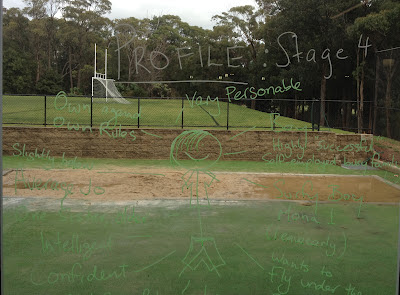
They are a school doing incremental things ... the "bunny hops" that they referred to - and I mentioned in a previous post. So - as well as using technology to develop the learning spaces they are adapting the physical spaces to try and enhance student learning.
Other examples I saw of this were a "home built" whiteboard as a tabletop - they were losing a whiteboard to make way for a folding door - so the students decided that they could build it into another work space and try it out as a desk. The result - the students (and teachers) loved using it as a brainstorming space.
So the takeouts remain ... they are not afraid to try things. Even small things. And there is a fundamental understanding with all staff and students.
They are all aware of, and can articulate, what their learning mission is.
They have done some stuff which is cool with their learning spaces.
Apart from knock down walls in older classroom blocks, they have also painted every surface with a surface coating (aka paint) that lets them write on any of the surfaces. Here's a couple of shots of an "older" classroom with a TV on the wall and notes next to it.


And then of course, the natural extension is that they can write on any surface at all - here's an example of some brainstorming from their last prof learning session that was still on the windows ...

They are a school doing incremental things ... the "bunny hops" that they referred to - and I mentioned in a previous post. So - as well as using technology to develop the learning spaces they are adapting the physical spaces to try and enhance student learning.
Other examples I saw of this were a "home built" whiteboard as a tabletop - they were losing a whiteboard to make way for a folding door - so the students decided that they could build it into another work space and try it out as a desk. The result - the students (and teachers) loved using it as a brainstorming space.
So the takeouts remain ... they are not afraid to try things. Even small things. And there is a fundamental understanding with all staff and students.
They are all aware of, and can articulate, what their learning mission is.
Wednesday, May 30, 2012
Redefining School Part 3
Still at Northern Beaches.
So - how does the school organise professional learning for staff with the large classes, technology to enable and pedagogy to support?
Each Monday afternoon all staff attend PL. Staff request sessions via word of mouth or an electronic request system. These requests are prioritised by the senior teacher i/c of PL and each Monday anywhere between 5 - 12 sessions are offered. Teachers opt in and their attendance is recorded in a reporting system that delivers a report to the HoF each term showing what has been attended by whom. This then provides a degree of review for future PL planning and helps identify for HoF, teacher and PL organiser any issues at the respective levels.
Expectation is that all staff attend. Reality is that at least 80% do. And because there is a record of who attended it is easy to identify and follow up those who don't.
Sessions might be on Moodle (for the first 2 years they were pretty much all Moodle); pedagogy, teaching methods, innovations, spirituality.
This information then also feeds into the appraisal system.
Once each term all staff spend 3 hours on a Wednesday (3:30 - 6:30) on a PL intensive which gives them enough time to do something substantive.
Tuesday, May 29, 2012
Redefining School Part 2
Northern Beaches Christian School featured in my last post. This post looks at their middle school "Learning Matrix". The students talk about the "matrix" in almost as reverent a term as we do about the movie. That's where the similarity stops though!
Basically the matrix is a combo of Bloom and Gardner with a range of activities in the matrix that are either compulsory or voluntary. Students must do the compulsory and can choose a range of the voluntary. This is a basic graphic representation of the matrix for Year 7 for term 2.

There is an element of gamification in the curriculum too. So while the tasks themselves are somewhat authentic, they also form part of the overall theme for the term which is usually related to some notion of puzzle/competition/investigative process. The students certainly seem to enjoy it. And that's important. In fact - the school believes that their behavioural problems have decreased by some 75% in the past 2 years as a direct result of the gamification of the curriculum where possible.
Basically the matrix is a combo of Bloom and Gardner with a range of activities in the matrix that are either compulsory or voluntary. Students must do the compulsory and can choose a range of the voluntary. This is a basic graphic representation of the matrix for Year 7 for term 2.

Students work on their "matrix projects" for around 6 x 70 minute sessions every two weeks, though as a year 7 syndicate teachers also share some of their maths, english, science and history work in the matrix too. This term the verbal tasks were all from the history curriculum and students were building websites or creating travel brochures in the "creating" and "evaluating" sections of the matrix.
Students work to achieve a certain "points total" for the term.
Each task (cell) is mapped to a range of outcomes from the NSW curriculum and teachers and students use a range of organisers to track their progress against these. These organisers range from printed sheets to Excel spreadsheets, but not many are done via Moodle - though I wonder if they will be able to use the Moodle rubric from 2.2 to make this more integrated than it is now.
Collaboration amongst staff is crucial here. The team/syndicate agree on the tasks and where they sit - after all, they all have to work with all of the students.
As a planning and curriculum coverage tool, this type of grid is useful in itself. Coupled with specific activities aimed at the various intelligences and taxonomies, it is even more useful. Linked to the LMS (Moodle) is yet a further strengthening of the entire process.
There is an element of gamification in the curriculum too. So while the tasks themselves are somewhat authentic, they also form part of the overall theme for the term which is usually related to some notion of puzzle/competition/investigative process. The students certainly seem to enjoy it. And that's important. In fact - the school believes that their behavioural problems have decreased by some 75% in the past 2 years as a direct result of the gamification of the curriculum where possible.
Redefining School Part 1
I'm lucky enough to be in Sydney this week touring a range of schools with a group of teachers from Christchurch and Southland. The purpose of the week is to learn about and from some of the schools and the remarkable teachers in them about technology initiatives that are working.
This post is the first of a few. Initially I thought I'd do each school as a separate post, but after today's session at Northern Beaches Christian School that idea went out the window. So much to talk about. So - humour me while I try and make a few points about some of the stuff I saw today.
 Northern Beaches Christian College was the venue for today. We were hosted by an interesting character. Steve Collis has the neat title of Director of Innovation at the Sydney Centre for Innovation in Learning (SCIL). Now, the SCIL was basically invented by the school, so that was the first learning byte - if you want something, invent it. (Sound like Alan Kay anyone? "Don't worry about what anybody else is going to do… The best way to predict the future is to invent it. Really smart people with reasonable funding can do just about anything that doesn't violate too many of Newton's Laws!"- I love that quote from 1971).
Well, Steve is a bit of showman. But - what I found by following him around the school was that this was one of the few schools I have been to where the talk was matched by the walk. Certainly in the Year 7 - 9 classes I saw anyway.
So ... what were the takeaways worth remembering ...


This post is the first of a few. Initially I thought I'd do each school as a separate post, but after today's session at Northern Beaches Christian School that idea went out the window. So much to talk about. So - humour me while I try and make a few points about some of the stuff I saw today.
Well, Steve is a bit of showman. But - what I found by following him around the school was that this was one of the few schools I have been to where the talk was matched by the walk. Certainly in the Year 7 - 9 classes I saw anyway.
So ... what were the takeaways worth remembering ...
- they've merged the physical space with the virtual space
- so - they have large teaching spaces - they've knocked down walls over about 10 years and now have large teaching spaces where learning happens. Up to 180 students and 6 teachers in the same space at the same time doing ... kind of the same thing, but with as many options as they have been able to agree to do as a team.
- they have learned the need to minimise noise by using special roofing tiles and walls that really do reduce noise - we were in a technology space where 75 students were working with various bits of equipment and talking - and we could see them from the other end of the room, but we couldn't hear them!
- What follows are a couple of images of some of the spaces. Comments as appropriate.

- what was interesting in this space was that the students (Year 7) were just at the end of a whole class intro session on whatever the content was ... so typical team teaching lecture style - nothing different, right? It was what happened when the leader/teacher said "get to work" that something was different. There were around 120 students in this group. They all got to work immediately - there was not a sound - so I presume it was an individual task - but not a sound. So - not sure that this was anything more than team teaching, but the students were clearly used to it and knew what was expected of them.
- Next space was a year 9 "Matrix" exercise - (more on the matrix in another post - its worth its own post). In this class I spoke with a couple of Year 9 students and one of the teachers.

- poor photography aside - you can see that the space is huge (this shows about half the space). Teachers simply worked with individuals or groups as required. Students knew what they had to do for the entire term and they were all working on their various tasks. Obviously the make-up of the task is important to this, that's the "Matrix" I'll refer to next post. The three students I spoke to could tell me exactly what they were doing and why and could easily navigate their online portal where all resources were. The portal is just Moodle (and 1.9 at that!) - but they have configured a landing page with the appropriate links to the pages/resources that students needed.
- the furniture is not standard either - there are a range of table types and sizes, and chair sizes and styles - and students are free to arrange the room how they want.
- they talk of 3 types of space
- the cave - a student wants to work alone
- the campfire - a small group want to learn from a master story teller
- the watering hole - everyone goes there at some stage and informal learning about anything can happen there
- each room or learning space can be configured to any or all of these at the same time
- the teacher I spoke with showed me how the Year 7 teachers had decided on the activities for the Matrix and how they monitored student progress and achievement. Despite all the work on Moodle, they used an Excel spreadsheet that linked the scores students gained from completing matrix work through to a map of the curriculum outcomes they were working with - so there is no doubt that there is a lot of teacher effort going in here.
- This next image is one from a newish building - taken using Photosynth on my iPhone (one of the more useful Microsoft tools). What this doesn't show is that there were 150 students in this Year 7 group - all working on a social studies project.

- The large screens here were simultaneously playing a series of video and still images designed to evoke some feelings amongst the students. The teacher I spoke to didn't know if the theory behind this playing of "subliminal images" worked or not - but felt there was some theory there.
And I guess that's the first takeaway. The school has clearly decided that they needed to back their changes with some theoretical base as well as a degree of "Alan Kay" - and invent their own future. So, the learning spaces are big and for a fair chunk of the school week students work in very large groups doing any number of tasks that are moderated by a team of teachers - who, while they have some nominal "class" teacher role, spend their time working with any of the students.
The kids I spoke with loved the freedom to "do what they want to" even though they were basically just picking from a set of given projects - but the range was pretty impressive.
Steve talked to us about a "love of learning" - in fact, the school holds this more important than outstanding academic results (though they will be related of course). They have taken time (10 years so far) to build the physical and virtual environments that overlap to provide the overall learning environment. The student numbers have increased from 200 in 2002 to 1200 in 2012. All students from Year 5 - Year 12 bring their own device - so students have Mac Books, iPads, Acer, HP, Dell, .... They use whatever applications they want. Staff cope.
The environment supports students ("free range chickens" Steve called them) and their ability to self navigate the curriculum. They trial it in small bits (bunny hops they call them) and modify - but always seeking to make the students central and use the environment and technology to facilitate.
It seems to work. In the next post I'll talk about the "matrix" and how they bring teachers along via their professional learning program.
Thursday, May 24, 2012
Hans Rosling on the World Population
Those of you who read these pages will know that I am a fan of Hans Rosling and GapMinder. His graphical analysis tools are cool.
So - here's his recent TED talk on the impact of Religion on Babies born ... watch for the simple explanation at the very end which uses some very simple technology to explain his view that the world population will peak at a certain level.
Enjoy - it's 13 minutes of enjoyment of maths, social science and thinking.
And by the way - the graphing engine that Rosling uses is either the same or similar as the graphing option in Google Apps spreadsheet - so if you haven't tried it yourself yet on some of your own data, then head to the Motion Chart option in Google's spreadsheet.
Sunday, April 29, 2012
ClassDojo - a simple way to motivate students
Have been meaning to write a quick note about a new tool that I have found gives a useful addition to a middle school class.
ClassDojo allows you to assign points to students in your classes for a variety of activities. These points can be both positive and negative ... And the software keeps track of the points over time. I have used it for about 6 weeks and am continuing with one of my classes this term as it seems to be helping with keeping students both on track and motivated.
Here is a view of the main class screen as it sits with my class at the start of this term.

The green scores are for positive behaviors and the red for negative. This display shows both values, though another setting displays just the net score, the positives less the negatives. I use the net score at an end of term prize giving whereby each point gives the student one entry into the draw for the term prize. The more positive points the more chances the student shave to win.
While it is still early days, offering positive points for extra work done is seeing students emailing in answers to extra work sheets at night, over weekends and on days when we don't even have mathematics. I'd love there to be an embed function so that I could embed the chart on my class Maths site - at the moment I capture the screen at the end of each week and post it on the site.
So - give ClassDojo some consideration - it's simple, but so far seems to appeal to the students and so worth a shot.
ClassDojo allows you to assign points to students in your classes for a variety of activities. These points can be both positive and negative ... And the software keeps track of the points over time. I have used it for about 6 weeks and am continuing with one of my classes this term as it seems to be helping with keeping students both on track and motivated.
Here is a view of the main class screen as it sits with my class at the start of this term.
The green scores are for positive behaviors and the red for negative. This display shows both values, though another setting displays just the net score, the positives less the negatives. I use the net score at an end of term prize giving whereby each point gives the student one entry into the draw for the term prize. The more positive points the more chances the student shave to win.
While it is still early days, offering positive points for extra work done is seeing students emailing in answers to extra work sheets at night, over weekends and on days when we don't even have mathematics. I'd love there to be an embed function so that I could embed the chart on my class Maths site - at the moment I capture the screen at the end of each week and post it on the site.
So - give ClassDojo some consideration - it's simple, but so far seems to appeal to the students and so worth a shot.
Subscribe to:
Posts (Atom)